
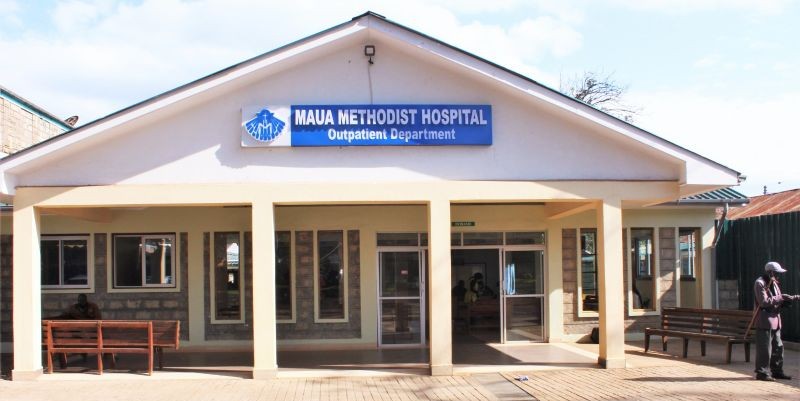
By Dr. Griffins Omondi – Maua Methodist Hospital
Earlier this year, a sudden halt to U.S. government-funded health programmes sent donor-funded initiatives across Kenya into crisis, disrupting the steady funding many HIV programmes had relied on for years. It forced an urgent response to realign health systems and patient services. Maua Methodist Hospital is one of several institutions that has recorded real success in its response to this disruption, a story we believe matters to everyone invested in Kenya’s health system, from our donors and partners to the patients we serve every day.
For years, an invisible boundary ran through Maua Methodist Hospital, not brick and mortar, but process. On one side sat the General Hospital, handling maternity, cancer treatment, and general care. On the other stood a separate HIV Clinic. Though this, separation grew out of a genuine need to combat an epidemic, it left patients living in effect, two separate medical lives, one file for HIV, another for everything else.
The Burden of the Silo
Imagine a mother from the outskirts of Meru County arriving at the hospital gates. She’s there for her routine antiretroviral refill, but she also has a persistent cough, and her toddler is due for a check-up. Under the old siloed model, her visit became a marathon: queuing at the specialized clinic for her medication, then crossing the compound to the General Outpatient Department for her cough, then finally making her way to the Maternal and Child Health wing for her child’s check-up. Each stop meant a new queue, a different clinician, and a separate medical file, by the time she reached the third desk, her patience was worn thin.
This fragmentation didn’t just burden patients like her; it created blind spots for our clinicians too. A cough treated in isolation might miss the context of a suppressed immune system, and a nutrition talk in one wing might overlook clinical markers recorded in another. We were treating a diagnosis, not a person.
The Courage to Change
Integration meant more than rearranging desks, it meant changing how our staff worked. We formed a dedicated Integration Committee with strong administrative backing, then invested in intensive on-the-job training, turning generalist nurses into HIV-competent providers and HIV specialists into holistic primary care clinicians. Many patients feared integration meant losing the privacy of a specialized clinic, so our Community Health Promoters and peer educators worked to bridge that gap, explaining that this was an upgrade to a one-stop shop, not a reduction in care. A three-month pilot let us refine the model on real feedback before scaling it up.
Scaling a New Reality
Six months after full rollout, the results speak for themselves: a zero percent attrition rate, and viral load suppression above 95%, proof that integration hasn’t compromised care, but strengthened it. For our donors and partners, this is evidence that investment in integrated care delivers measurable, lasting impact. For our patients, it means one visit, one file, one team looking after their whole health.
A Leaf for the National Tree
Maua Methodist Hospital sees this as a meaningful contribution to Kenya’s Universal Health Coverage goals, made possible through the continued mentorship and partnership of CHAK. We invite our peer institutions, and the donors and stakeholders who support this work, to see what’s possible when care is built around the person, not the illness.